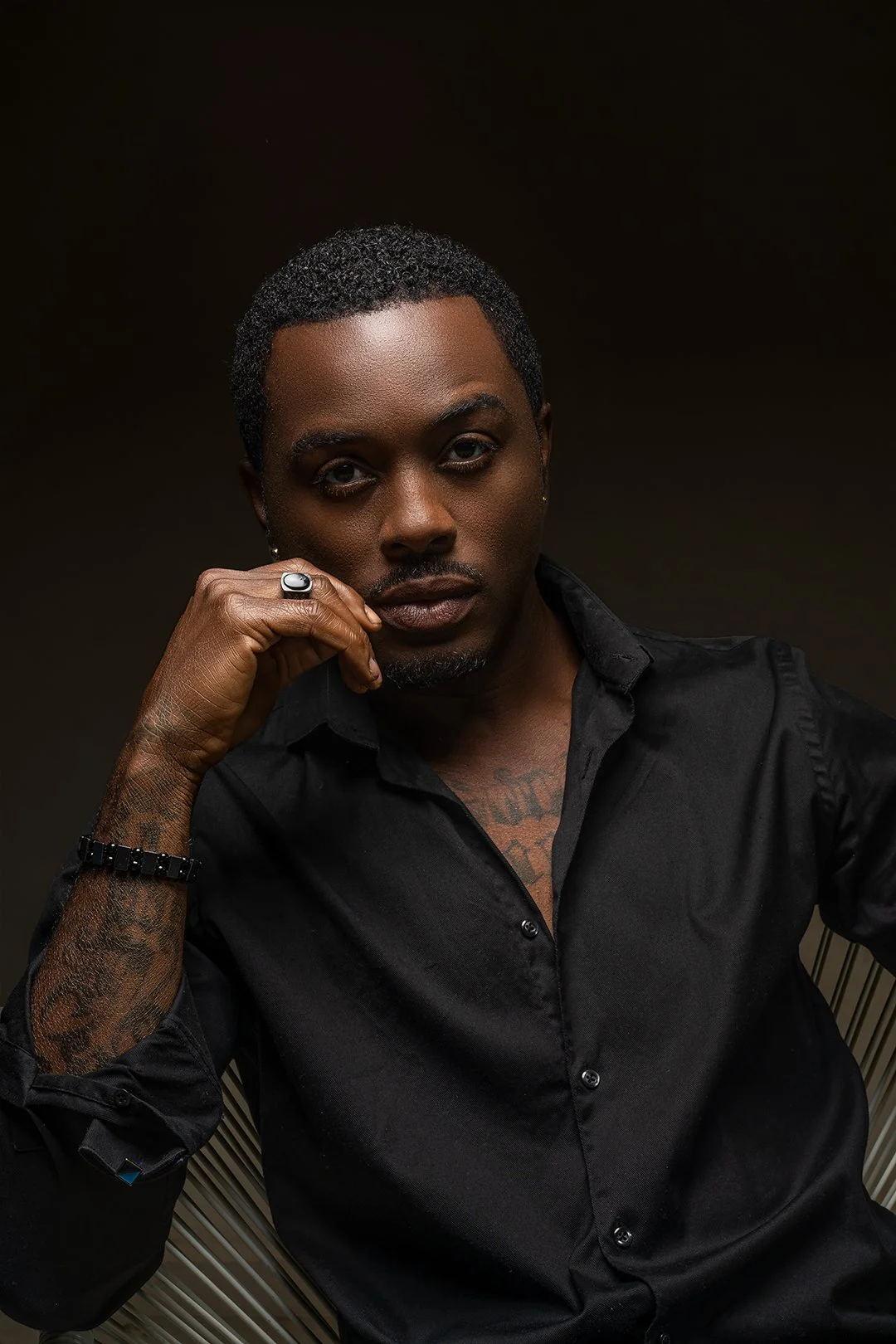
Médéric Turay
Mederic Turay (b. 1979, Abidjan, Ivory Coast, lives and works in Marrakech, Morocco) is a multidisciplinary storyteller who lives his art as a privilege and uses a plurality of techniques to create entities, sometimes figurative, sometimes abstract, which become the protagonists of his graphic stories. Turay was raised in the United States in the 1990s, where he was introduced to hip hop music, graphic novels, and the works of Picasso, Van Gogh, and Basquiat. He returned to the Ivory Coast as an adult to pursue his art education, and travelled widely in Africa in search of source materials and inspiration. Turay’s incandescent, vast canvases stage beguiling storylines of his global background and represent his effort to distill, through the performative physicality of painting, the essence of the contemporary human experience in our transactional, post-colonial society.
Turay’s concept of “human with a capital H” is one that transcends racial, geographic and socio-political stereotypes. A descendant of the noble Akan people of West Africa, Turay also seeks to connect with his heritage by appropriating motifs such as ancestral masks and spiritual symbols.
The balance of life forces, symbolized by two complementary forms : the cross and the spiral, in a way his yin and his yang. The spiral, round and infinite, refers to the movement of the cosmos, the dynamism, the creative fertility. Conversely, the cross, rigid in straightness, symbolizes anchoring, stability and material concretization. It is most often in the eyes of his characters that he inserts these cosmogonic symbols. For him, balance in duality leads to happiness. Turay’s multi-media surfaces pulsate with an eclectic, raw energy. His new body of work is more abstract and introspective, assembling coarse coffee grinds, sumptuous oil and acrylic brushstrokes, and locally sourced pigments to create a multisensory, cacophonous experience of depth. His images are so cosmic in scope that they require viewers to suspend their imagination to explore their nuanced juxtaposition of many contrasting energies. The temptation to decode Turay’s complex and voluminous sampling of inherited traditions and new forms leads to a meditative plunge into his polyphonic story of existence. These images document his quest of truth seeking and urgently proclaim the power and necessity of painting in this global, mass media age.
Médéric Turay
Mederic Turay (né en 1979 à Abidjan, en Côte d’Ivoire ; vit et travaille à Marrakech, au Maroc) est un conteur multidisciplinaire qui considère son art comme un privilège et utilise une multitude de techniques pour créer des entités, tantôt figuratives, tantôt abstraites, qui deviennent les protagonistes de ses récits graphiques. Turay a grandi aux États-Unis dans les années 1990, où il s’est familiarisé avec la musique hip-hop, les romans graphiques et les œuvres de Picasso, Van Gogh et Basquiat. De retour en Côte d’Ivoire à l’âge adulte pour poursuivre ses études artistiques, il a beaucoup voyagé en Afrique à la recherche de sources d’inspiration et de matériaux. Les toiles vastes et incandescentes de Turay mettent en scène des récits envoûtants inspirés de son parcours international et témoignent de sa volonté de distiller, à travers la physicalité performative de la peinture, l’essence de l’expérience humaine contemporaine dans notre société transactionnelle et postcoloniale.
Le concept de « l’humain avec un H majuscule » de Turay transcende les stéréotypes raciaux, géographiques et sociopolitiques. Descendant du noble peuple Akan d’Afrique de l’Ouest, Turay cherche également à renouer avec son héritage en s’appropriant des motifs tels que les masques ancestraux et les symboles spirituels.
L’équilibre des forces vitales, symbolisé par deux formes complémentaires : la croix et la spirale, qui constituent en quelque sorte son yin et son yang. La spirale, ronde et infinie, renvoie au mouvement du cosmos, au dynamisme, à la fertilité créatrice. À l’inverse, la croix, rigide dans sa rectitude, symbolise l’ancrage, la stabilité et la matière.